

Beyond the Task
As AI unbundles work into tasks, leadership must redefine what makes people and organizations worth following.


I’ve come to believe that organizational narratives and personal narratives are not separate disciplines. They are different expressions of the same human system. Organizations don’t transform unless the people leading them do. People rarely reinvent themselves without changing the systems and communities around them.
That’s been front of mind over the past few weeks as I’ve begun work with a new client focused on the future of work. I’ve found myself back inside familiar questions about AI, organizational redesign, and how work itself is being unbundled and rebundled into tasks. It’s a category I’ve worked in before, but this time it feels different.
The work has taken me back to notes from the AI and Economics summit at UC Santa Barbara, where economists, computer scientists, and researchers explored a deceptively simple question: What is the most cost-effective way to complete a task?
At first glance, it sounds like an operational discussion.
It isn’t.
It is a conversation about the future architecture of human value.
I’ve also been weaving together insights from Amy Webb’s Convergence work, Sangeet Paul Choudary’s research on reshuffling work, and Kevin Kelly’s recent essay describing latent space as a new medium for intelligence. Different perspectives. Different disciplines. Yet they all seem to point toward the same destination.
The more I connect the dots, the more I believe we are standing at the beginning of a much larger shift than most organizations realize.
NOW
For generations, organizations hired people to perform jobs.
Increasingly, they are purchasing outcomes by orchestrating tasks.
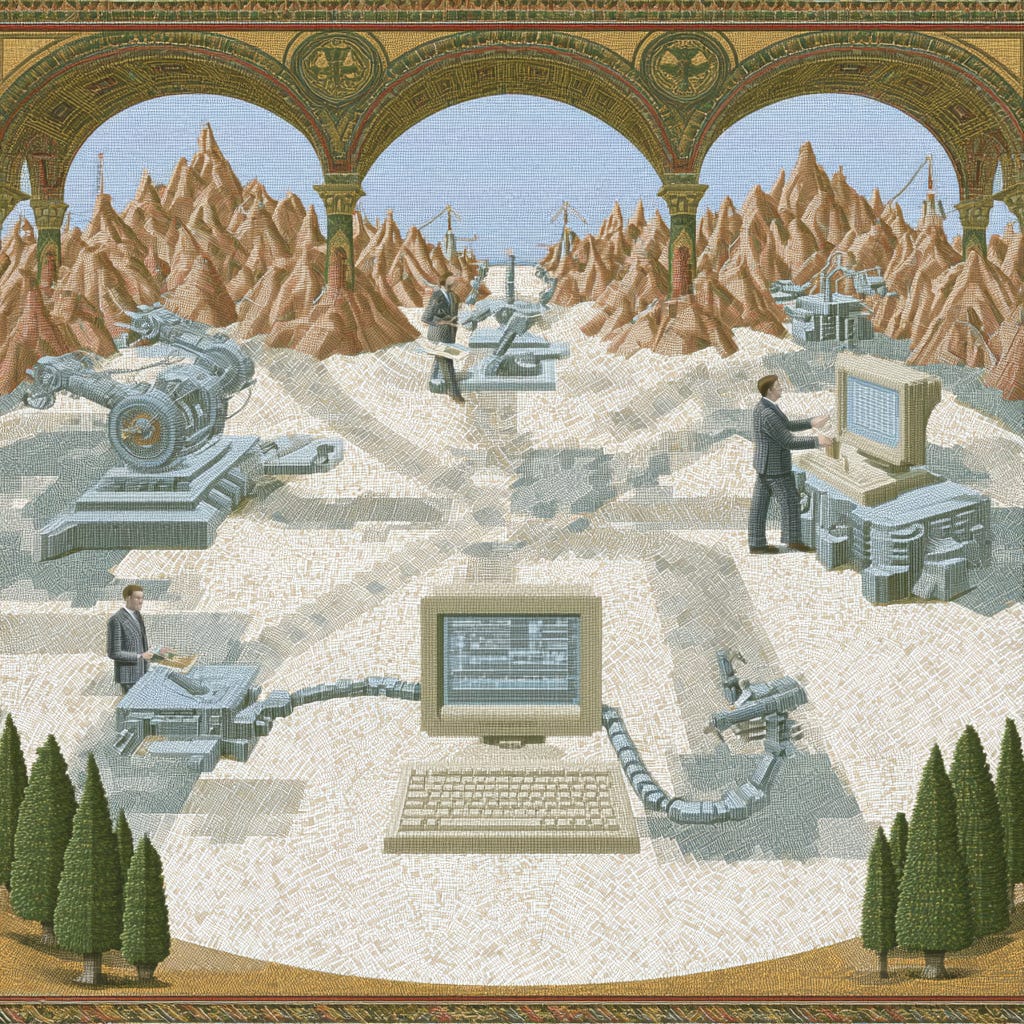
Work is being unbundled into smaller units, evaluated for efficiency, and then rebundled across humans, AI, software, and automation in whatever combination produces the best result.
The question is quietly changing.
It is no longer:
“Who should do this work?”
It is becoming:
“What is the best combination of capabilities to achieve this outcome?”
For many executives, this is an exciting operational challenge.
For many employees, it is something entirely different.
Because while companies are reorganizing work, people are simultaneously trying to understand where they fit inside the new equation.
As tasks become easier to replace, worth becomes harder to define.

NEW
This is where I think many leadership conversations miss the deeper story.
Most discussions focus on task replacement.
Very few acknowledge identity disruption.
For decades we’ve introduced ourselves through our professions.
“I’m a marketer.”
“I’m an engineer.”
“I’m a project manager.”
“I’m a lawyer.”
Those weren’t merely descriptions of what we did.
They became part of who we believed ourselves to be.
When work is decomposed into hundreds of individual tasks, those identities begin to loosen.
That helps explain why organizational transformation is rarely just about technology.
It is about people trying to reconcile a changing world with a story they’ve spent years telling themselves.
Companies experience this as resistance to change.
Individuals experience it as uncertainty.
In reality, they are responding to the same shift from opposite sides of the table.

NEXT
This is why I increasingly believe the next era of leadership won’t be defined by managing tasks.
It will be defined by creating meaning.
Organizations will still need strategies, operating models, and AI roadmaps.
But they will also need leaders capable of helping people understand where they belong as work continues to evolve.
The same is true for each of us.
If AI can perform more of the tasks that once defined our careers, then our enduring value will come less from what we do and more from how we think, connect, adapt, and help others navigate change.
Perhaps that is the deeper opportunity hiding beneath all of the discussion about AI.
The future of work isn’t only asking organizations to redesign jobs.
It is asking all of us to reconsider what makes us worth following, hiring, trusting, and remembering.
That question is much bigger than work.
It may become the defining question of Narrative Worth™.

Narrative Worth Principle #1
Organizations don’t transform unless the people inside them do. People rarely transform without changing the systems around them.

If you know a company or someone who is trying to make sense of a new chapter of growth, clarify their story, or is in need of designing a new category, send them this issue. The most valuable thing I can do is provide a fresh perspective to someone who can’t see it.
I’m Tobin Trevarthen.
I spent the first thirty years of my career inside organizations, building brands, leading partnerships, and helping companies shape the stories that moved markets.
Over the last twelve years, I’ve worked across companies, countries, industries, and executives, helping organizations find the narrative that aligns people around meaningful change.
Along the way, I realized something unexpected.
The work was never just about organizations.
It was about people.
Because organizations don’t transform unless the people inside them do.
That realization became the foundation for everything I do today.
I don’t believe our lives unfold in straight lines.
I believe they accumulate like mosaics.
Every experience becomes another tile. Every success, setback, relationship, reinvention, and lifequake changes the larger picture. The image only becomes clear when we step back far enough to see how the pieces belong together.
I call that accumulated value Narrative Worth™.
Today, I work with founders, executives, and leaders at the moments when their old story no longer explains where they’re headed next. Together we reconnect the pieces, uncover the patterns, and build a narrative that others can believe in because they believe it themselves.
Some of my most rewarding work is with neurodivergent leaders whose greatest strengths often sit outside conventional frameworks. Their mosaics were never incomplete. They simply needed to be seen differently.
That is the work of SpatialShift™.
Because I believe your Narrative Worth™ is the most valuable asset you will ever own.