

Crossing the Chasm
When strategy becomes personal


There are moments when an idea you’ve spent years talking about suddenly stops being theoretical. It becomes embodied.
This week, I’m packing up a house we’ve lived in for eight years. Eight years of routines. Objects. Papers. Old decks. Old assumptions. And, from a Napa perspective, living through harvests.
All artifacts of who I was becoming, who I was being, and who I thought I needed to remain to co-exist in a fast-changing society. We lived the COVID years here. Our business, Kitchen Collective, brought us here to redefine the meaning of breaking bread with friends and community.
At the same time, I’m stepping into 65 and toward my Word of the Year for 2026 - Reimagine, beginning January 3rd.
Not as an aspiration, but as a commitment.
Which is when it hit me.
I’m not writing about crossing the chasm.
I’m in it.
Geoffrey Moore famously described the perilous gap between early belief and mainstream adoption in Crossing the Chasm.
What the book doesn’t dwell on is this: The same chasm also exists in a life.
Between who you’ve been and who you know you can no longer be.
Between comfort and coherence.
Between staying impressive and becoming true. The chasm of performative self versus intuitive self that you now get to impart in new ways. The calling of AI adds to the curiosity to realize a dream you had decades ago, can now be realized, and you are tasting the possibilities.
NOW: Standing at the Edge
There’s a strange disorientation that happens when you start letting go.
You don’t miss things yet. You notice their weight.
Boxes fill with reminders of past versions of competence.
Job titles. Speaking decks. Notes from moments when the world applauded a certain shape of you. The big stages. The dramatic sleepless nights. The endless pursuit of perfection and polish.
None of it is wrong.
But none of it is sufficient anymore.
This is the phase most people avoid.
The pause before momentum.
The silence before the next sentence.
The chasm is not dramatic at first.
It’s quiet.
It asks uncomfortable questions:
Who are you without the scaffolding?
What stays when the proof points are packed away?
What part of your identity have you been outsourcing to habit (good and bad)?
This is not failure.
This is friction.
And friction is often the signal that something real is about to happen. In narrative terms, I refer to this as resistance.

NEW: The Liminal State
Anthropologists have a word for this. Liminality.
The space between. No longer what you were. Not yet what you’re becoming.
It’s an unstable state.
Which is why institutions rush people through it.
Why resumes demand continuity.
Why bios prefer clean arcs, versus squiggly broken lines and gaps.
But liminality is where reassembly happens.
This is where anti-fragility lives.
Not in certainty.
Not in control.
But in the willingness to be temporarily undefined.
I’m discarding more than objects right now.
I’m shedding reflexes.
Old reward systems.
Outdated definitions of relevance.
Crossing a chasm requires trust.
Not blind optimism.
But earned trust in your inner compass.
You don’t leap.
You commit.
And commitment looks like this:
Saying yes before the path is visible.
Choosing coherence over reassurance.
Letting the next version of you pull harder than the last one clings. And, trust me, the cling is real.

NEXT: The Other Side Is Not the Point
Here’s the part most people get wrong.
The goal isn’t to arrive safely on the other side.
The goal is to become someone capable of “Crossing the Chasm” again.
That’s the long game.
At 65, I’m not optimizing for scale.
I’m optimizing for alignment.
For narrative agency.
For a life that can adapt without erasing itself.
The chasm will keep appearing.
New technologies. New identities. New seasons.
AI didn’t create this reality. It revealed it.
Those who cling to past containers will experience every change as loss.
Those who practice becoming will experience change as composition.
This is the work beneath ShiftStory.
Not reinvention theater.
Not personal branding.
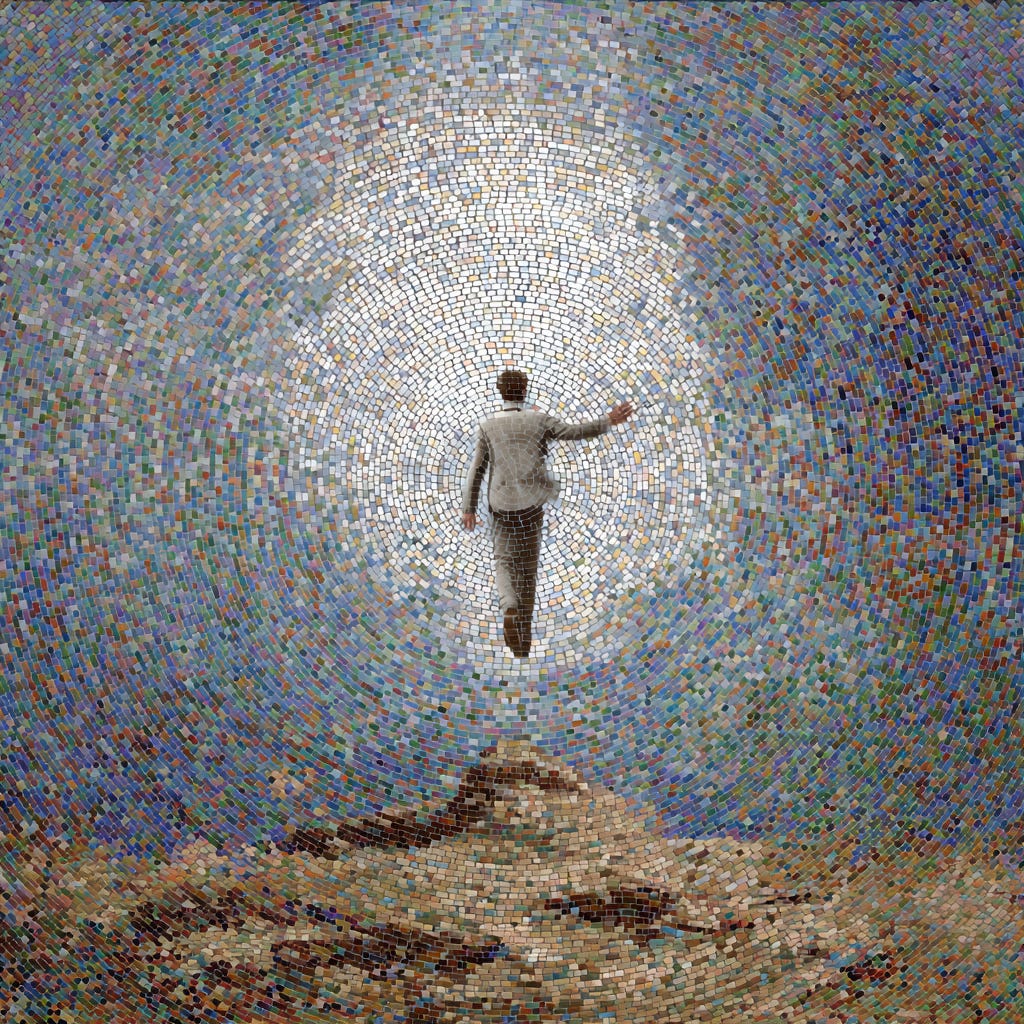
But the discipline of reassembling your fragments into something honest, resonant, and alive. A vision I refer to as a “living mosaic”.

THE PAYOFF: Crossing Is a Choice
In the Now, we recognize the edge.
In the New, we stay long enough to feel what’s being asked of us.
In the Next, we move forward without pretending we have it all figured out.
Crossing the chasm is not a career move.
It’s a character decision.
You don’t cross because you’re certain.
You cross because staying would require you to become smaller.
As I close one house and step toward a new chapter, I’m reminded of this.
The most meaningful transitions don’t reward speed.
They reward honesty.
And the courage to say: This version carried me far. The next one will carry me true.
If you’re standing at your own edge, take your time.
But don’t turn back out of habit.
The chasm is not the threat.
Avoiding it is.
“Technology enthusiasts embrace innovation for its own sake; the mainstream, however, demand a complete product solution before they take the leap.”
— Geoffrey A. Moore

I’m Tobin Trevarthen.
I work with people who sense that something in their story is no longer aligned, even though things appear to be working.
My work is not about reinvention or performance. It is about orientation. Helping people locate where they are inside change before deciding what comes next.
ShiftStory™ is the container for that work.
A disciplined, human way of seeing clearly when familiar narratives no longer quite fit.
I’m less interested in scale than in accuracy. Less interested in telling people who they could become than in helping them hear who they already are.
If something here resonates, you don’t need to agree with it. You only need to notice it.
That’s usually enough to know whether a conversation would be useful.
Follow me on LinkedIn. DM at tobin@spatialshift.com or sign up for the ShiftStory™ here: https://shiftstory.co/
This is an incredible piece of writing, I'm living the same experience, it's scary and magical.